
For years, I thought of AI as a robot:
Give it an instruction, get a result.
Like a calculator, but fancier.
Until one day, scrolling through social media, I came across a post from someone who said AI helped them recover from trauma.
Not code faster. Not automate work.
But heal.
I know a thing or two about trauma myself, and while I’ve lived through my own version of it, never had I thought about AI as a way to process grief, pain, or even confusion.
That got me thinking.
AI as a Mirror, Not Just a Machine
If you’ve been using AI for a while and have been patient enough to learn how to speak to it, something strange happens.
It reflects your ideas back at you.
It helps you make sense of your own words.
It’s like tipping a puzzle box onto the floor and having it gently assemble the pieces in front of you.
That’s how I’ve always thought of using AI: as a tool for clarity.
But what if it’s more than that?
What if it could be:
- a friend
- a therapist
- someone you could confide in without fear of judgment
That’s what this stranger online had done. He had used AI not just to think but to feel.
The Unspoken Barrier: Trust
I realised why this felt so alien to me.
It wasn’t because I didn’t believe AI could help.
It was honestly because I didn’t trust it.
Or perhaps didn’t trust it enough to let it in.
I didn’t want to pour my heart out to a robot and have my feelings stored on a server somewhere, packaged for the Chinese government.
But mostly because, deep down, I believed emotions were the one thing that made us uniquely human—the one thing AI could never touch.
But then I saw this person’s story, and it made me pause.
Maybe what AI is or isn’t is not the point.
Because what matters is what it does for you.
Artificial, but Still Real
Here’s a thought experiment:
Artificial sweetener is, by definition, “artificial.”
But it still makes your coffee taste sweet.
So does the source really matter if it provides the effect?
AI can help you process your emotions, organize your thoughts, or even make you feel less alone.
Yes, we know it’s not a “real” person —
But does that diminish its value?
We already accept artificial things in other parts of our lives:
Synthetic fabrics. Digital books.
Why is emotional support any different?

What Science Is Beginning to Show
The research is still early, but studies are starting to reveal both the promise and the pitfalls of AI in emotional support.
On the positive side:
- A 2017 randomized controlled trial by Fitzpatrick and colleagues found that young adults using the Woebot chatbot experienced a significant reduction in depression symptoms after just two weeks of daily interaction.
- A 2025 systematic review of AI-powered CBT chatbots highlighted the efficacy of Youper, which helped reduce depression by 48% and anxiety by 43%.
- A 2022 study on the XiaoE chatbot showed that users formed stronger therapeutic alliances and reported higher acceptability compared to those using a general chatbot or reading an e-book.
But there are also concerns:
- Dr. Allen Frances, writing in The British Journal of Psychiatry, warned that AI chatbots may actually cause harm for patients in severe crisis — sometimes validating dangerous thoughts instead of encouraging necessary reality testing.
- A 2025 analysis of AI healthcare apps by Yener and colleagues revealed serious privacy gaps, noting that none of the reviewed apps had clear policies for notifying users of data breaches.
- Clinicians interviewed in a 2025 study expressed concern that AI cannot detect subtle nonverbal cues — like tone, eye contact, or body language — which risks missing signs of escalating distress.
So the evidence cuts both ways. AI can help—but it’s not a cure-all.
A Friend, Not a Replacement
Does this mean AI can replace human connection?
I don’t think so.
Humans need humans. We’re wired for touch, tone, and empathy—the subtle cues of another living being.
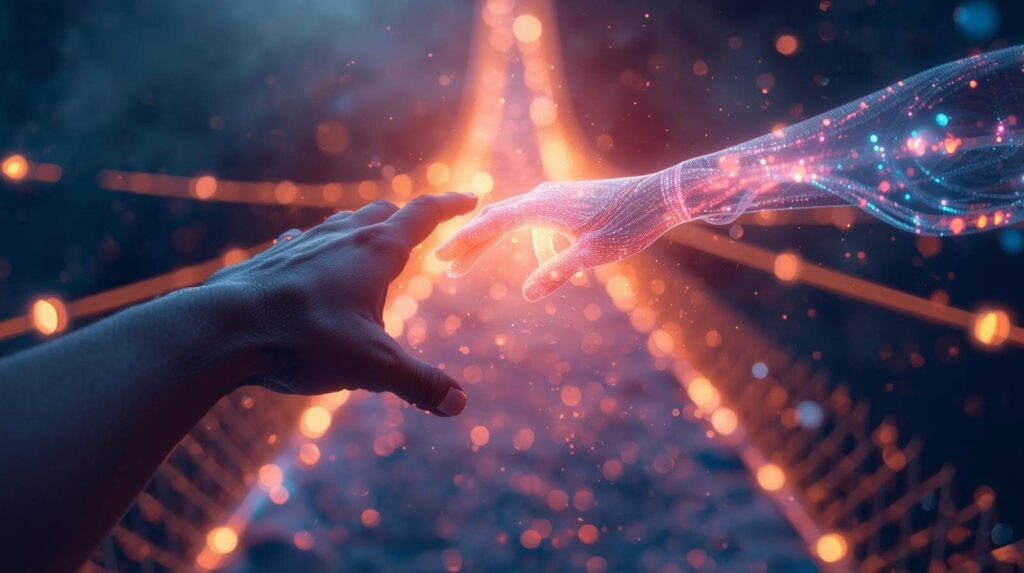
But AI can be a bridge.
It can be a mirror.
It can be a practice ground for expressing yourself safely or for learning how to articulate complex feelings before you bring them to a real person.
And that’s not something to fear.
The Choice Is Ours
Artificial intelligence is what we make of it.
It can be a calculator.
It can be a co-pilot.
It can be a quiet space where you start to untangle your own mind.
It’s not here to replace you.
It’s here to reveal you.
The question isn’t “Can AI replace human connection?”
The question is:
“How will you choose to use it?”
Thanks for reading!
Sources
- Fitzpatrick et al., 2017 – Delivering Cognitive Behavior Therapy to Young Adults With Symptoms of Depression and Anxiety Using a Fully Automated Conversational Agent (Woebot): A Randomized Controlled Trial
- Farzan et al., 2025 – Artificial Intelligence-Powered Cognitive Behavioral Therapy Chatbots: A Systematic Review
- He et al., 2022 – Mental Health Chatbot for Young Adults With Depressive Symptoms: A Single-Blind Three-Arm Randomized Controlled Trial
- Frances, 2023 – Warning: AI Chatbots Will Soon Dominate Psychotherapy
- Yener et al., 2025 – Can I Trust This Chatbot? Assessing User Privacy in AI-Healthcare Chatbot Applications
- Hipgrave et al., 2025 – Clinicians’ Perspectives on the Use of Generative AI Chatbots in Mental Health Care